

Picture it. You’re Mickey Haller, a.k.a. Michael Connelly’s Lincoln Lawyer. You’re following a man who will hurt your family if you don’t bury evidence in a murder trial. While you weave through foot traffic, from behind comes a hand on your arm and a knife at your back.
What do you do?
Turn and fight? Try to pull away and run? Play along, and see how it evolves?
If it were the real you in that situation, how do you think you’d react?

And the winner is…
The term fight or flight was introduced in 1915 by Harvard physiologist Walter Bradford Cannon, when Cannon saw how animals reacted to danger. As theory and research evolved, it expanded to fight, flight, or freeze. You may see or fawn added as a fourth, depending on the source.
The gist? When we feel threatened – even if it’s psychologically instead of physically (public speaking, anyone?) – our adrenaline pumps, and it fuels these knee-jerk reactions for our survival.
Which one is best? Whichever one keeps you alive!
Ideally, our instincts pick the best reaction to survive the situation: fight if you’re cornered, run if you’re near an exit, and freeze – or try to appease – if the first two aren’t possible.
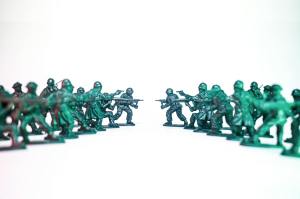
But…we call them crime FIGHTERS
A novel’s action scenes are meant to stand out; we often simply say fight scenes. Do we assume that Mickey not only will stay and fight, but that he should? We want maximum drama.
In reality…many of us have a “go-to” response; a person tends to fight, or flee, or freeze, or fawn, whenever we feel threatened. The temperaments we’re born with play a role.
We also become more rigid if we over-learn one style, from years of fighting off a rough older sibling, or placating a domineering parent. If you become a hammer, everything looks like a nail. If you’re a placater, everyone looks like a person who can be placated. In crime fiction, we expect some tough characters with honed instincts for fighting.

When truth is stranger than fiction
The truth, though, is the most effective move in the crisis-of-the-moment might not be one we’re wired for. The more trained and rigid we are in our ways, the harder it will be to see that, and to act accordingly.
Dr. Deadly loves it when characters wrestle with this on the page. Readers of Janet Evanovich’s Stephanie Plum series are entertained by Stephanie reacting in all the ways in lighter scenes: running in with mace cans and tasers, slipping away from hilarious messes, and playing along with kooky characters.
In some emotionally raw scenes, however, Stephanie fears actual death, and we experience her heart-stopping, mind-numbing freeze. That’s her initial, automatic response. But each time she pries herself out of it and pushes to fight if needed, or figure out how to escape if she can. Evanovich does great justice to what it feels like to work through the adrenaline of those moments, as well as the physiological crash afterward.
The list of crime fiction protagonists whose nervous systems are wired to fight is likely long, and that makes sense. But it can spice up plots and character development if they work toward the ability to shift into flight, freeze, or fawn mode, when those are wiser choices to defeat the villain.
Do any such protagonists or novels come to mind, dear reader? Or are there any protagonists you’d like to see wrestle with needing to change their style now and then? Let Dr. Deadly know below!






Leave a Reply